
Brockton, Mass. | July 14, 2026 | Yves Cajuste / InfoHaïti.net |
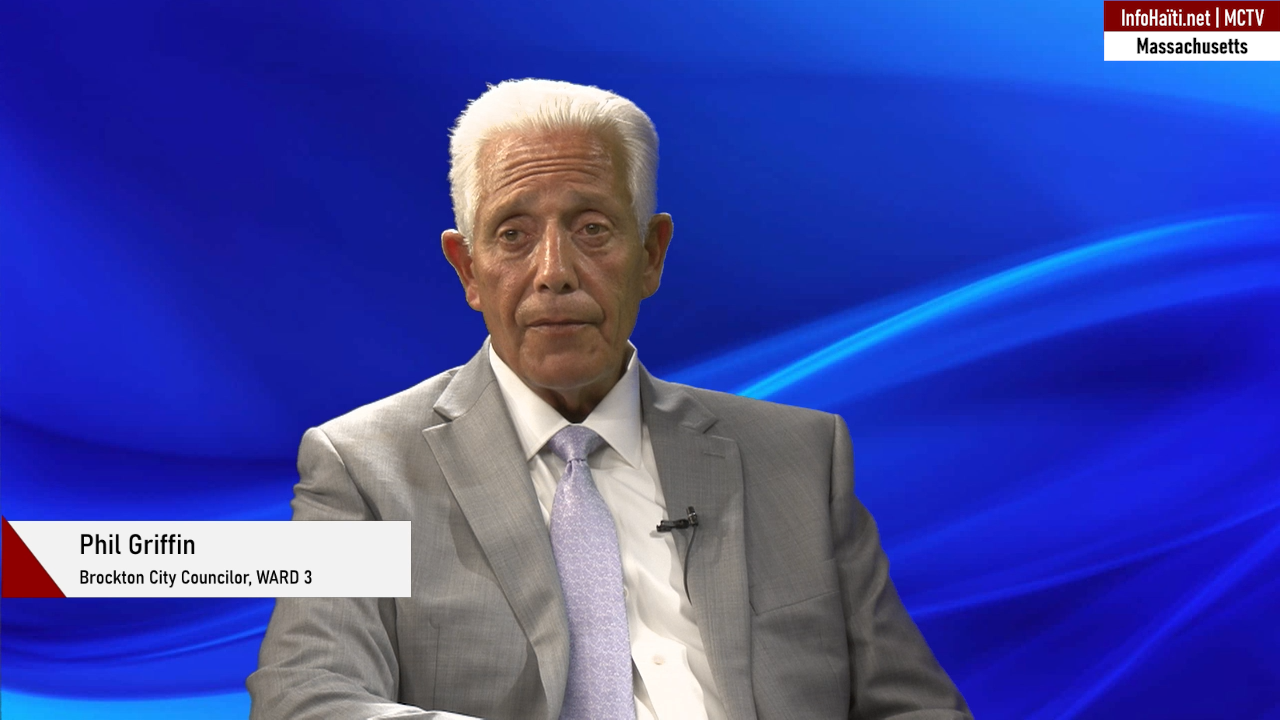
“Economic development must become Brockton’s top priority if the city hopes to strengthen public safety, improve schools, and reduce pressure on homeowners”, Ward 3 City Councilor Philip E. Griffin said during an interview on the local television program All About Brockton, produced by MCTV (Multicultural Television Network) and hosted by Ronald Bernard.
Griffin, a second-term councilor and lifelong Brockton resident, said expanding the city’s commercial tax base is the most effective long-term strategy for generating revenue to fund municipal services without placing a greater burden on residential property owners.
“The city really only has two avenues for revenue — commercial taxes and residential taxes,” Griffin said. “You can’t continually put the pressure on homeowners. You have to expand your commercial tax base.”
A retired law enforcement officer, Griffin said he entered public service after raising his family and completing his career, motivated by a desire to give back to the community where he grew up and attended public schools.
Much of the interview centered on economic development, which Griffin described as the key to addressing many of Brockton’s most pressing challenges.
He identified the long-planned redevelopment of the 66-acre Brockton Fairgrounds as the city’s most significant economic opportunity. According to Griffin, successful redevelopment of the site could generate between $5 million and $10 million annually in new tax revenue, providing resources to hire police officers, teachers, and code enforcement personnel while supporting other essential city services.
Griffin also pointed to the Belmont Street corridor as another area with strong redevelopment potential, citing its large commercial properties and proximity to major transportation routes.
However, he argued that Brockton’s permitting and regulatory processes discourage investment.
Drawing on his experience as former chairman of the Brockton Redevelopment Authority, Griffin said developers often face lengthy approval timelines and duplicative requirements that increase costs and make projects less attractive.
“In development, time is money,” Griffin said, calling for streamlined regulations that would allow projects to move more quickly from planning to construction.
Griffin said commercial growth is directly tied to improving public safety.
While praising the city’s new Public Safety Building on Warren Avenue, he said Brockton needs significantly more police officers to adequately serve a city of its size. Rather than relying on temporary grant funding, Griffin argued that sustained commercial development would generate the recurring revenue needed to strengthen the police, fire, and other municipal departments.
Housing also remains a major concern, Griffin said, as affordability challenges and homelessness continue to affect residents.
He praised nonprofit organizations that provide emergency assistance but said permanent solutions will require greater financial support from state and federal governments.
“The city does not have the funds to do that,” Griffin said, noting that some individuals experiencing homelessness also require long-term mental health or addiction treatment before they can transition to permanent housing.
Griffin also expressed strong support for building a new Brockton High School, describing the current facility as outdated while emphasizing the educational value of expanding vocational and career technical programs.
He cautioned, however, that the project’s total cost remains uncertain because state reimbursements will not cover every component, including certain athletic facilities. Any local borrowing, he noted, would ultimately require voter approval through a debt exclusion.
“I think philosophically everybody would love to have a new high school,” Griffin said. “But it’s going to boil down to whether families can absorb the increase in their taxes.”
Philip Griffin highlights a positive working relationship with Mayor Moises Rodrigues
Discussing the recently adopted fiscal 2027 budget, Griffin explained that while the City Council cannot add spending to the mayor’s proposed budget, it may reduce appropriations. He said his priorities focused on maintaining funding for public safety and education despite the city’s financial constraints.
Griffin also described his working relationship with Mayor Moises Rodrigues as positive, saying both share a commitment to economic development and improving city services, even if they occasionally differ on strategy.
Looking ahead, Griffin said Brockton has the potential to transform itself over the next five to 10 years if city leaders simplify the development process and attract new private investment.
“We’re all in this together,” Griffin said. “If we can get development going and more revenue into the city, we can build new schools, hire more police officers, hire more teachers and move Brockton forward.”