
Brockton, Mass. — July 21, 2026 — Yves Cajuste, InfoHaïti.net — Brockton City Council President Jack Lally has outlined six priorities he views as essential to the city’s future: modernizing infrastructure and municipal services, easing residency requirements to expand the pool of public-sector applicants, ensuring transparency in financing a proposed new high school, strengthening cooperation between the Mayor and City Council, promoting housing and economic development, and improving communication with all residents.
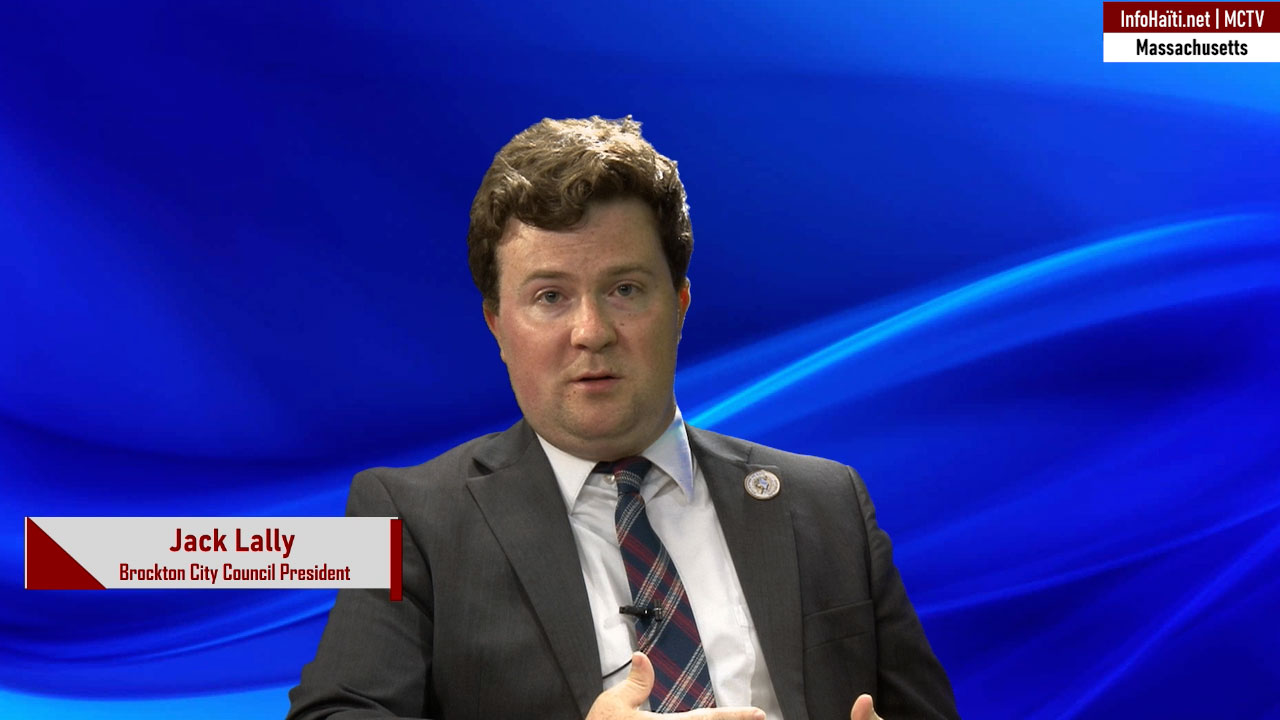
Lally discussed those priorities in a July 21 interview with Ronald Bernard on “All About Brockton,” a television program produced by MCTV.
Born at Brockton Hospital and raised in the city, Lally said his interest in public service grew out of his experiences in his neighborhood. Conversations among residents made him aware at an early age that municipal decisions were not always clearly explained or understood by the public.
“It seemed to me that some policies could be improved and their impact was not always clearly explained to residents,” he said.
Lally was first elected to the City Council in 2015 at age 18, becoming the youngest elected official in Brockton’s history. He is now serving his sixth term on the council, representing Ward 6. He said his first campaign taught him that earning voters’ trust begins with direct communication.
“You have to meet residents, listen to their concerns, explain the issues and try to help address their problems,” Lally said. He added that personal contact, particularly door-to-door campaigning, remains more effective than relying primarily on campaign mailers.
Cooperation with Mayor Moises Rodrigues
Lally described his working relationship with Mayor Moises Rodrigues as regular and constructive. As he did with former Mayor Robert Sullivan during his previous term as council president in 2022, Lally said he meets frequently with the city’s chief executive.
The meetings allow him to bring councilors’ concerns to the mayor while helping council members better understand the administration’s policies and proposals.
“Municipal government cannot function without close cooperation between its two branches,” Lally said. Poor communication between the executive branch and the council, he added, can delay action, especially when councilors do not have all the information they need before voting.
Potential areas of cooperation include the future of the Aquaria desalination plant and efforts to ease some of the financial pressures facing the city. Lally said Rodrigues has been “very willing to meet with us and have discussions.”
Lally also said Brockton is in a period of transition that could create significant development opportunities. The city’s expected increase in borrowing capacity, plans for a new high school, the recent opening of the public safety complex on Warren Avenue, the approaching expiration of the Aquaria contract and consideration of a new zoning code all provide opportunities to shape Brockton’s future, he said.
“We are at a pivotal moment, and we have to decide which direction we want to take,” Lally said.
Public safety and residency requirements
On public safety, Lally called for regular communication among the City Council, police and fire departments, and other municipal agencies. Working with Ward 5 Councilor Jeffrey Thompson, chairman of the council’s Public Safety Committee, Lally said he helped restore periodic reports from public safety officials.
The Police Department’s primary staffing challenge is not a lack of funding for positions, Lally said, but an insufficient number of applicants. He attributed the shortage in part to rules requiring certain municipal employees to live in Brockton.
Experienced police officers and military veterans living in nearby communities may decide against joining the city’s workforce because they do not want to sell their homes, move their children to different schools or disrupt their family lives, he said.
“Qualified candidates ultimately choose to work for other communities,” Lally said.
He supports replacing the residency requirement for public safety hiring with a system that gives preference to Brockton residents without excluding applicants from elsewhere.
Any change would have to be negotiated by Rodrigues through collective bargaining agreements. Lally said the change could help fill positions already funded in the city budget and strengthen community policing.
“Such a measure would increase officers’ presence in the community and help them build closer relationships with residents across Brockton’s neighborhoods,” he said.
Building upward to support housing and business growth
As housing costs rise, Lally said Brockton should expand its commercial tax base to ease the burden on homeowners. The city uses a split tax rate under which businesses pay a proportionally higher share than residential taxpayers.
However, Lally said Brockton’s commercial sector is not yet strong enough for the city to take full advantage of that system.
He supports mixed-use development that combines housing, businesses and public spaces, particularly downtown. A proposed form-based zoning code could allow taller buildings in exchange for public benefits such as green space, public art or rooftop restaurants.
“The more broadly the cost of municipal government is shared, the less it weighs on each individual taxpayer,” he said.
Areas including Montello, Campello and downtown are already the focus of plans aimed at encouraging investment. Lally said the city must do more to promote its strengths and development opportunities.
“Brockton needs to do a better job of showcasing its assets, accomplishments and development opportunities to make the city more attractive,” he said.
Over the next decade, Lally would like to see carefully managed urban density, with more office and residential buildings in areas suited for taller construction. Building upward, he said, could address the shortage of available land while preserving neighborhoods made up largely of single-family homes.
Water, sewer and municipal broadband
Calling infrastructure essential to the functioning of a city, Lally placed municipal utilities at the center of his long-term development strategy.
He supports strengthening Brockton’s water and sewer systems, exploring the acquisition of the Aquaria desalination plant — which provides a supplemental source of drinking water — and selling excess water to neighboring communities whose groundwater supplies are contaminated or running short.
Revenue from those sales could help control rates for Brockton residents, finance the replacement of aging pipes before they fail and pay for road repairs above water and sewer lines.
Lally also supports creating a municipal high-speed internet service. Subject to federal and state approval, the network could connect to a major fiber-optic line running through underground conduits along Main Street.
He also wants the city to study the feasibility of establishing a municipally operated electric utility, similar to those in Taunton and Braintree, where rates are generally lower.
A NEEDED NEW high school, but financing questions remain
Lally said Brockton needs a modern high school but emphasized the project’s enormous financial implications. The total cost could exceed $800 million and potentially reach $1 billion. A 5% increase over an $800 million budget would add $40 million to the project.
“It will be the most expensive project the city has ever undertaken,” he said.
The proposed HIGH school would continue to offer a traditional academic curriculum while expanding vocational and technical training in fields where workers are in high demand.
Before moving forward, however, city officials must determine how much funding the state will provide, how much the city can borrow and what share taxpayers would have to cover.
Financing could require a temporary debt exclusion, which would allow property taxes to rise above the usual limit for the life of the debt. Such a proposal would have to be approved by voters.
“When the project goes before the voters, there cannot be any vagueness, unanswered questions or missing details,” Lally said.
He also noted that the state would not necessarily reimburse every feature included in the project, such as a possible swimming pool.
Improving communication with every community
Lally said the city should make greater use of social media, email and text alerts while strengthening its partnerships with community organizations.
He welcomed the recent hiring of a Haitian Creole-speaking employee in the city clerk’s office, adding to services already available in Spanish, Portuguese and Cape Verdean Creole.
The change should help the municipal government respond more effectively to the needs of Brockton’s diverse population, he said.
Lally also called for closer coordination among nonprofit organizations, churches and youth groups to avoid duplicating programs and to serve more residents.
In closing, the council president encouraged residents to attend public meetings, review city documents online, contact their elected officials and participate in elections. Of the roughly 15,000 people in his ward, only about 2,000 typically vote, he said.
“Stay engaged, stay informed and don’t hesitate to ask questions,” Lally said, adding that government works more effectively when residents and the news media hold it accountable.
“It is the taxpayers’ money,” concluded Brockton City Council President Jack Lally on MCTV-produced program “All About Brockton”.